Reviewed · GUIDED
Bucharest: Romanian Athenaeum Guided Tour
This private guided visit to the Romanian Athenaeum turns a big landmark into a clear, personal story you can walk through. I love that you step from the grand exterior into the luminous circular vestibule, and then into the horseshoe concert hall built for sound. I also love the panoramic Costin Petrescu fresco, where Romanian history is painted scene by scene. One consideration: the tour is only 1.5 to 2 hours, so if you want to linger, bring comfy shoes and a steady pace.
With the guide Iana Bradu, the focus stays practical and concrete, from the six Ionic columns to why the dome shapes acoustics. You’ll get English (and sometimes Romanian) explanations, plenty of photo time as long as you skip flash, and lots of chance to ask questions. The main drawback for some people is simple: this tour is not suitable for children under 6.
Key things to know before you go
- Plan for acoustics and architecture: the dome, vestibule, and horseshoe seating are explained as a single sound system
- See the Costin Petrescu panoramic fresco: Romanian history from Roman times through the Great Union of 1918
- Get the Give a leu for the Athenaeum story: how 19th-century fundraising helped create a national cultural symbol
- Expect music-culture context: the George Enescu Philharmonic Orchestra connection is part of what you learn
- You may catch rehearsal sound: depending on timing, you could hear orchestra warming up or singers practicing
- Use the artists’ entrance: meet at the side entrance on the right, beside the front steps
Entering Bucharest’s Romanian Athenaeum With Iana
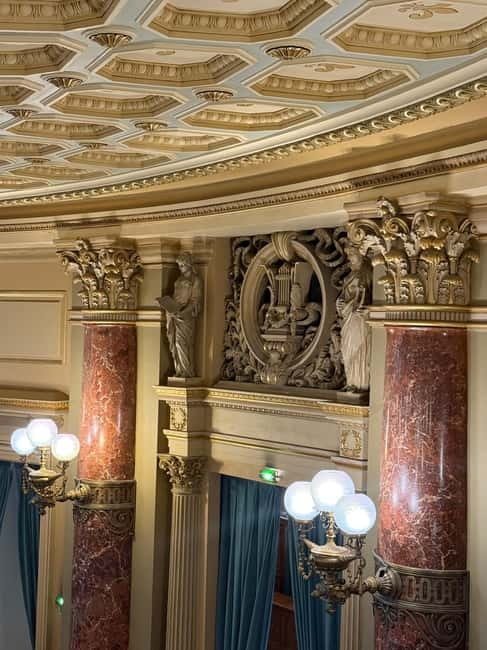
The Romanian Athenaeum is one of those places that looks impressive from far away, then gets even better when you step inside. The big win here is the guide. Iana Bradu doesn’t just point out decorations, she connects what you see to what it meant to Romanians when the building was created and how it still works today as a concert home.
You’ll move through the building in a logical way, starting at the exterior façade and ending at the concert hall space where sound matters. The pace is good for photos, and the explanations stay anchored in details: shapes, materials, and symbolism. If you like architecture and music culture, this tour gives you both without turning it into a lecture.
Do note the practical limits. Flash photography isn’t allowed, and since this is a guided walkthrough that spends real time inside, you’ll want shoes you can stand in.
More Bucharest options to weigh up
- Bucharest: Dracula’s Castle, Peles Castle, & Brasov Old Town
★ 4.5 · 17,858 reviews - Bucharest: Dracula Castle, Peles Castle & Brasov Old Town
★ 4.6 · 10,891 reviews - Bucharest: Dracula’s Castle, Peleș Castle & Brașov Day Trip
★ 4.4 · 6,100 reviews
Outside the Athenaeum: Ionic columns and the meaning of the façade
Your tour begins with the front experience most people see first, but you’ll look at it differently after the explanation. The Romanian Athenaeum’s exterior is neoclassical, and the façade is built around six Ionic columns. Ionic columns are a deliberate choice, not decoration for decoration’s sake, and you’ll learn what the columns were meant to signal: balance and artistic spirit, plus that idea of wisdom tied to classic temple design.
This is also where the story behind the building gets traction. You’ll hear about the 19th-century fundraising campaign called Give a leu for the Athenaeum. It’s not just trivia. It helps you understand why this building became a cultural landmark beyond being beautiful. When you know people literally contributed small sums to make it happen, the monument stops feeling like an art object from a textbook and starts feeling like something built by a community.
If you like taking photos, this is your moment. The façade is dramatic, and photos come out well from the exterior approach. Just remember you’ll be inside shortly, so don’t spend so long shooting that you run out of time for the hall and fresco.
Inside the circular vestibule: marble, the dome, and sound
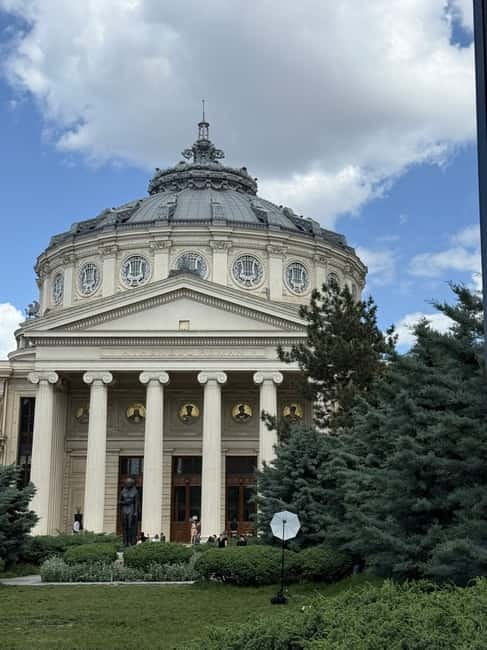
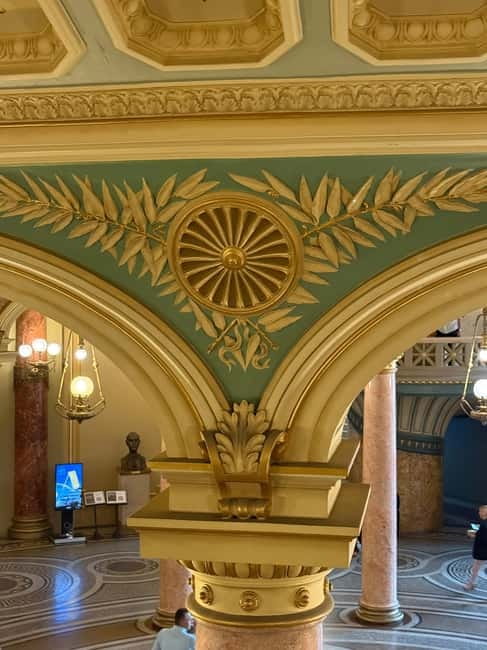
Once you cross into the Athenaeum, the tour becomes about what makes the building perform. The first interior space is the circular vestibule. Expect bright light, marble floors, and a layout that feels like a transition between street-level Bucharest and a proper temple for music.
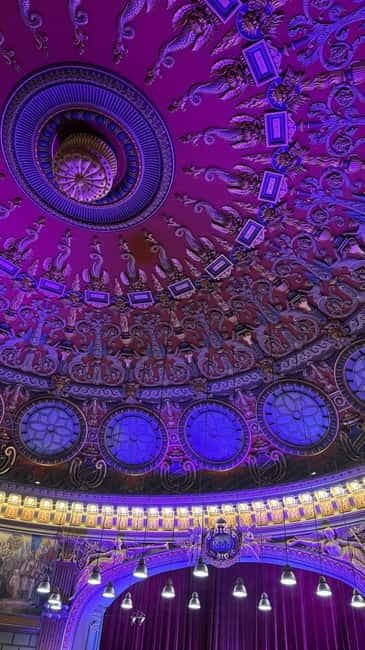
The dome is a key feature you’ll learn about early. It’s not only about looks. The dome’s shape and placement are tied to how the space supports acoustics. This matters because the Athenaeum’s concert hall isn’t just attractive. It’s designed to carry sound clearly. As you move toward the auditorium, the guide’s explanations help you notice how the room is “set up” for listening, not just watching.
If you’re the type who likes to understand why a place works, this part will click. You’ll start seeing the building as a coordinated system: entrance space, dome, and then seating geometry.
The horseshoe-shaped concert hall: nearly 800 seats and why it matters
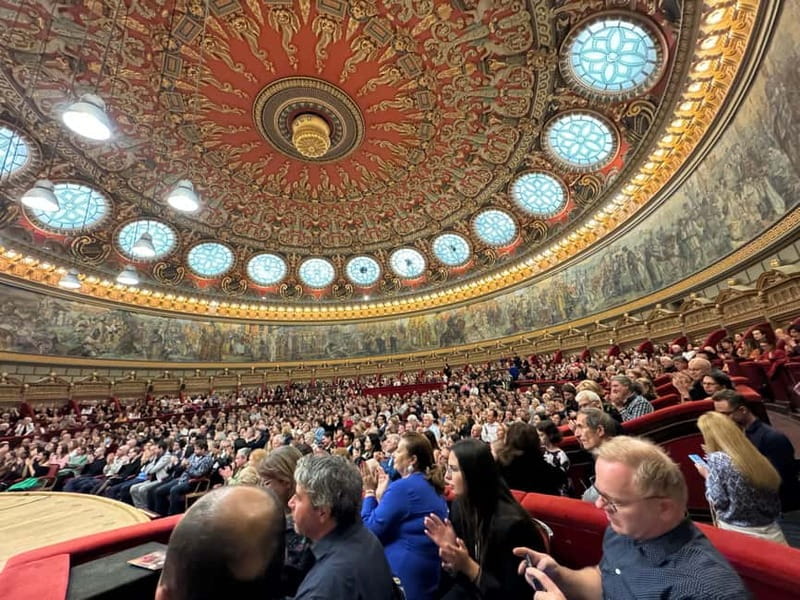
The highlight for many people is the concert hall itself. The auditorium is horseshoe-shaped and designed to hold nearly 800 people. That number is helpful because it explains why the architects had to make acoustics work at real scale, not in a tiny studio.
What I like about how the tour handles this is that it keeps the focus on experience. You’re not left with vague praise. You learn how architectural harmony contributes to hearing, and you get a sense of what makes the hall famous.
And if your timing is lucky, this is where the day can turn extra memorable. Several guests report hearing rehearsals or orchestra warming up, including instances with Christmas singers practicing. That doesn’t happen every single time, of course, but if it aligns with your visit, it makes the architecture feel instantly practical, like you’re learning the acoustics from the inside of the sound.
Even without music in the background, standing in that hall after the explanations is usually a wow moment. The room has presence, and the guide helps you interpret it.
Same base, a completely different day:
- Bucharest: Palace of Parliament Tickets and Guide
★ 4.3 · 3,182 reviews - Bucharest: Day Trip to Dracula Castle, Peles Castle & Brașov
★ 4.4 · 3,049 reviews - Bucharest to Dracula Castle, Peles Castle and Brasov Guided Tour
★ 4.5 · 2,933 reviews - Bucharest: Palace of Parliament Tickets and Guided Tour
★ 4.4 · 1,877 reviews
The Costin Petrescu panoramic fresco: Romanian history told in scenes
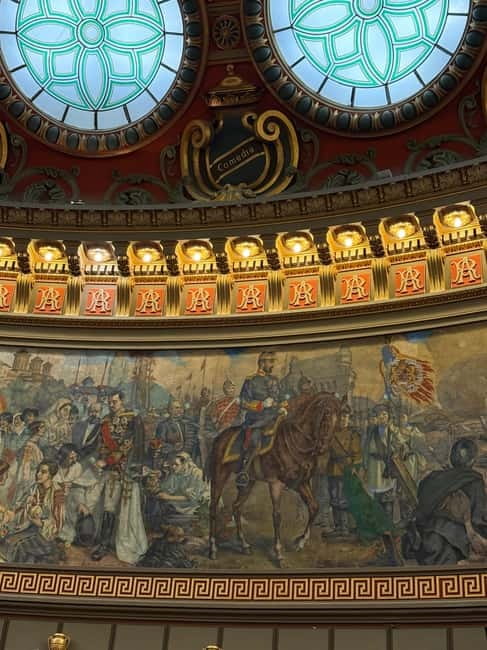
A big reason people book this tour is the fresco, painted by Costin Petrescu in the 1930s. The mural is panoramic, meaning it wraps the story across a broad field of view rather than being one small panel. Expect Romanian history presented in sequence, with scenes moving from Roman conquest through medieval times and then toward the Great Union of 1918.
What you’ll notice during the tour is that the guide helps you read the painting. You’re not just staring at figures, you’re following symbols and historical meaning. That’s the difference between seeing a mural and understanding it.
If you’re worried this will be too artsy and not enough facts, don’t. The guide ties it back to the bigger theme of national identity, and the fresco’s layout makes it easier to keep the chronology straight. It also pairs nicely with what you learned outside, especially the Give a leu campaign. Together, they help you see how the building became a stage for identity, not just a concert venue.
The Athenaeum as a cultural home: George Enescu Philharmonic context
Inside, the tour doesn’t treat the hall as a museum piece frozen in time. You’ll learn about the Athenaeum’s role as the home of the George Enescu Philharmonic Orchestra. That connection helps you understand why the building is still important, not only because it’s historic but because it still hosts concerts and cultural events that shaped Romanian artistic life.
This matters for how you evaluate value. If you only came for architecture, you might leave thinking you saw a pretty interior. But with this music context layered in, the Athenaeum becomes a living part of Bucharest’s cultural rhythm. It’s easier to plan your next step too, like checking out performances when your schedule allows.
If classical music is your thing, you’ll likely appreciate how the guide frames the building’s reputation in relation to what comes through its doors. If you are less into music, you still get something useful: a better sense of why people care here and what this building protects and continues.
What makes Iana’s tour style work so well
The standout theme is how Iana handles details without getting lost in them. You’ll hear clear explanations about the decorative features, plus context that ties those features to the building’s purpose.
The best part is pacing. In several accounts, guests mention that Iana makes space for photos, asks if you need extra time to look, and keeps the tour unhurried. That might sound small, but it makes a real difference in places like this. When you rush, you miss how the shapes guide your eye and how the domed space changes your sense of sound.
I also like that the tour feels personal. People often come away with practical next-step recommendations from the guide, including ideas for other nearby sights. Some guests even describe extra time outdoors around the area near the Athenaeum, such as a stroll involving Amzei, plus helpful pointers on Bucharest beyond the building itself. That kind of added local direction can turn a short tour into a better trip overall.
Price and value for a 1.5 to 2 hour private tour
At $44 per person for a private guided tour lasting about 1.5 to 2 hours, the price looks reasonable if you want guided access to the key interior spaces. You’re not paying just for entry. You’re paying for someone to explain what you’re looking at: architecture, the fresco story, and the George Enescu Philharmonic connection.
Here’s how I think about value on this kind of tour:
- If you’re someone who reads signs and moves on fast, a self-guided stop might feel cheaper.
- If you want context, the fee starts making sense because the Athenaeum’s meaning is layered. Without explanation, the fresco and symbolism can feel like decoration plus a few dates.
- Since this is private or small groups, you also get more time for questions and slower looking, which is perfect in a building where details reward attention.
If your schedule is tight, this is also a strong option because the tour duration matches the time window most visitors can manage without sacrificing an entire afternoon.
Timing tips: when to go and what to bring
This is a walk-and-stand tour inside and outside. Bring comfortable shoes, water, and your camera. Flash photography is not allowed, so plan to take photos in natural light settings rather than trying for quick flash shots.
If you are hoping for rehearsal sound, your best odds come from choosing a time that matches the building’s live program. The tour itself doesn’t guarantee rehearsal access, but luck does happen. In the past, guests have reported hearing the orchestra warming up and catching practices by singers.
Once inside, take a breath before rushing from room to room. The vestibule and dome are part of the acoustic story, and you’ll understand it better if you slow down for a minute and look upward. The same goes for the fresco: give it a few minutes and let the guide walk you through it scene by scene.
Who should book this tour, and who might skip it
Book this if you:
- care about architecture and want the why behind the what
- want Romanian history presented through art you can actually see
- like connecting music venues to the bigger culture around them
- would enjoy a guide who can explain details clearly in English
Consider skipping if you:
- only want a quick exterior photo and are not interested in interior storytelling
- dislike standing for guided walking, even for a short 1.5 to 2 hours
- are visiting with children under 6, since it is not suitable for them
Should you book the Romanian Athenaeum guided tour?
Yes, if you want your visit to feel like you understand the building, not just that you visited it. The best reason to book is the combination: neoclassical architecture, a meaningful panoramic fresco, and the way the space connects to the George Enescu Philharmonic Orchestra. I also think the private guide format is where the value lives, because the explanations make the fresco and hall far easier to interpret.
If you can only do one cultural stop in Bucharest that blends art, music, and national story in the same place, this is a smart choice.
FAQ
How long is the Romanian Athenaeum guided tour?
The tour lasts about 1.5 to 2 hours.
Where is the meeting point?
Meet at the side entrance on the right, just beside the front steps of the Romanian Athenaeum. This is the artists’ entrance, and the guide Iana waits outside.
Is this a private tour?
It is a private or small group tour.
What languages are available for the guide?
The tour is available in English and Romanian.
Can I take photos during the tour?
Yes, photography is allowed, but flash photography is not allowed.
What is included in the tour?
The tour includes a private guided visit of the Romanian Athenaeum, architecture and history insight, stories about the George Enescu Philharmonic Orchestra, and viewing the panoramic fresco by Costin Petrescu.
Is the tour suitable for children?
It is not suitable for children under 6.
What should I bring?
Bring comfortable shoes, your camera, and water.
Latest reviews from around Bucharest
- Bulgaria Day Trip – Private Tour from Bucharest – Veliko Tarnavo & Arbanasi★ 5.0 · 4 reviews
- Black See, Constanta and Mamaia Beach – Day Trip from Bucharest★ 5.0 · 4 reviews
- LiBEARty Brown Bear Sanctuary and the most important castles from Romania★ 5.0 · 4 reviews
- Hike Bulgaria Love Swing, Veliko Tarnovo and Tarevet Fortress★ 5.0 · 4 reviews
- Bucharest Private Tour with Dracula’s Grave and Ceaușescu Mansion★ 5.0 · 4 reviews
- Dracula Experience In Transylvania★ 5.0 · 4 reviews
- Hiking in Bucegi Mountains in the Carpathians, Private tour★ 5.0 · 4 reviews
- Bison Sanctuary, Vlad the Impaler Princely Court & Dracula Grave★ 5.0 · 4 reviews
Guided, compared.

Bucharest: Palace of Parliament Tickets and Guide
Read our review →
Bucharest to Dracula Castle, Peles Castle and Brasov Guided Tour
Read our review →
Bucharest: Palace of Parliament Tickets and Guided Tour
Read our review →
Bucharest: City Highlights Guided Walking Tour
Read our review →
Bucharest: Communism and History Guided City Walking Tour
Read our review →
Bucharest: Dracula Castle, Peles Castle & Brasov Guided Tour
Read our review →