
Reviewed · WALKING TOURS
Cluj-Napoca: 2.5-Hour Guided Walking Tour
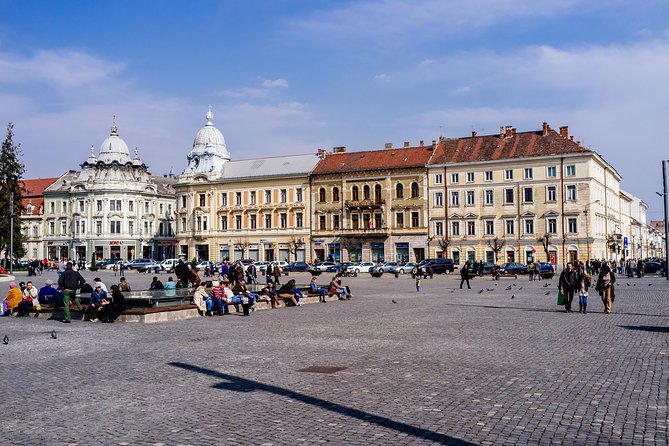
Cluj-Napoca is interesting because it plays like a mini Central Europe history lesson, right in the open air. This 2.5-hour walk strings together German, Hungarian, and Romanian threads, from Matthias Corvinus to Gothic churches and big public squares. The only drawback is that it is still a walking tour, so it is not a great match if you tire fast.
I like that the tour keeps moving with context, not just photo stops. Guides such as Daniela, David, Andrei, Adrian, and Urzica have explained the how and why in English and German, often with an adjustable pace and a chance to sit for a bit. If you are hoping for lots of interior visits, you may want to know what is possible before you go.
Key highlights you will actually remember
- Matthias Corvinus birth house plus wine stories that connect a famous king to everyday regional life
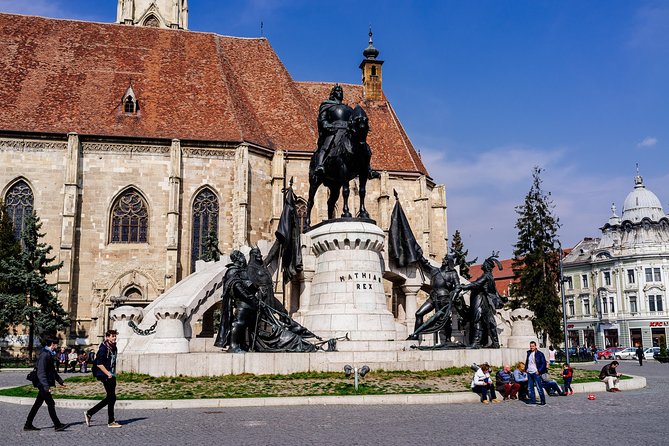
- St. Michael’s Church on Union Square and its striking Gothic look from the outside
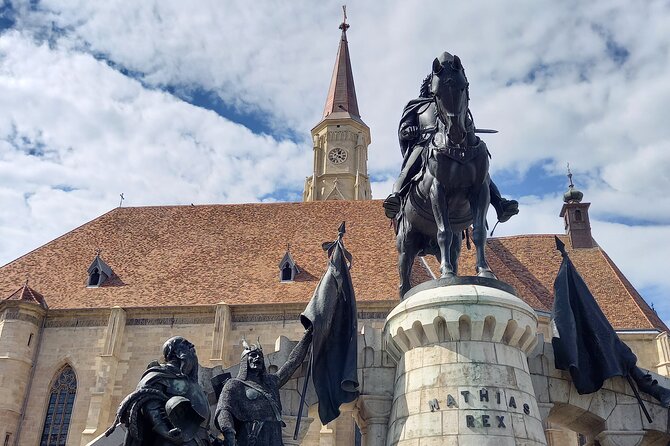
- The Corvinus equestrian statue placed right where the history gets legible
- Street of the Intellectuals and Babes-Bolyai University as Cluj’s learning corridor
- Medieval witch stories and guild formation explained along the streets, not in a textbook
- Avram Iancu Square with a 1930s Orthodox cathedral and a 1906 National Theatre
Starting in Cluj: why this 2.5 hours works
This tour is built for orientation. You get a guided route through Cluj-Napoca’s most important old-city landmarks, but what makes it useful is the thread tying them together. Instead of isolated facts, you get a sense of how the city kept changing rulers, languages, and faiths, while staying recognizably Cluj.
The route also gives you both “big postcard” stops and smaller story stops, like defensive-wall remnants and street-level details linked to medieval life. That balance matters if this is your first day. If you already know the names of sights, you will get a fast map in your head. If you do not, the guide’s explanations help you connect what you see to what it means.
Time is a real factor, too. At 2.5 hours, it is long enough to feel like a proper walk, not just a quick taste. And from the feedback I saw, the pace can be adjusted, with a couple sit-down pauses so the tour does not become a nonstop march.
More Walking Tours in Cluj-Napoca
- Cluj-Napoca: 2.5-Hour Guided Walking Tour
★ 4.5 · 29 reviews - Cluj-Napoca Walking City Tour
★ 4.5 · 16 reviews - Cluj : Must-See Attractions Walking Tour
★ 4.8 · 8 reviews
Matthias Corvinus birth house and the wine angle
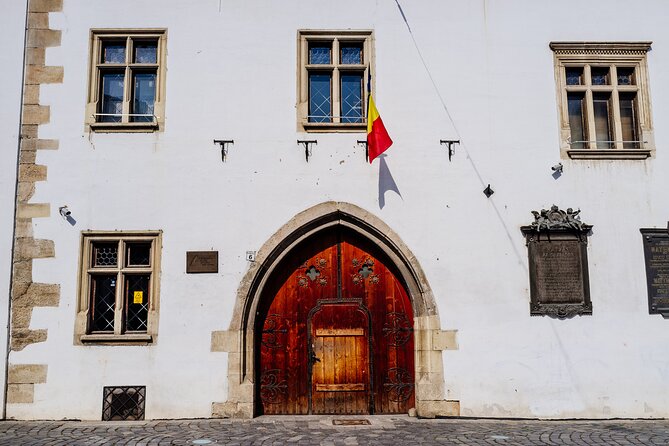
One of the first anchors is the birth house of Matthias Corvinus, Hungary’s well-known 15th-century king. This is not a random “famous name” stop. You get stories about Matthias’s life and, importantly, the role wine played in the region.
That wine detail is smart for two reasons. First, it gives you a clue about why people settled and prospered around particular places. Second, it helps explain why the city’s culture was never just about politics and kings. It was also about work, trade, and what sustained daily life.
From a visitor’s point of view, this stop helps you understand Cluj’s position in Central Europe. When you hear about Matthias here, the later squares and churches stop feeling like separate monuments. They become part of the same long story.
St. Michael’s Church on Union Square, plus Corvinus in bronze
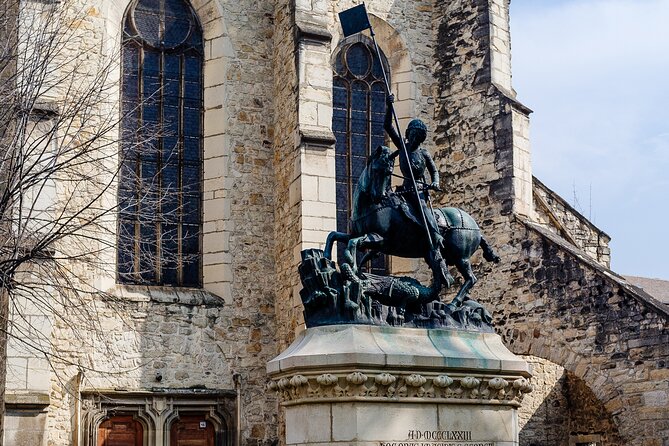
Next comes Union Square and St. Michael’s Church, a Gothic landmark from the 14th century. Even if you are not a church-architecture person, the scale and shape land immediately. Gothic churches are built to pull your eyes upward, and that works in photos, but it also works when you are standing there in real time.
The tour also includes the large equestrian statue of Corvinus resting in front of the church. Seeing the statue in the space it occupies matters. It is one thing to read about a king. It is another to stand in a public square where the city visually “puts him” into the present.
If you like history explained in a way that makes street geography matter, this is a strong section. You can practically follow the logic of power and symbolism: a king, a church, a square. The guide’s comments help you understand why those things sit together the way they do.
Street of the Intellectuals, Babes-Bolyai, and medieval witch stories
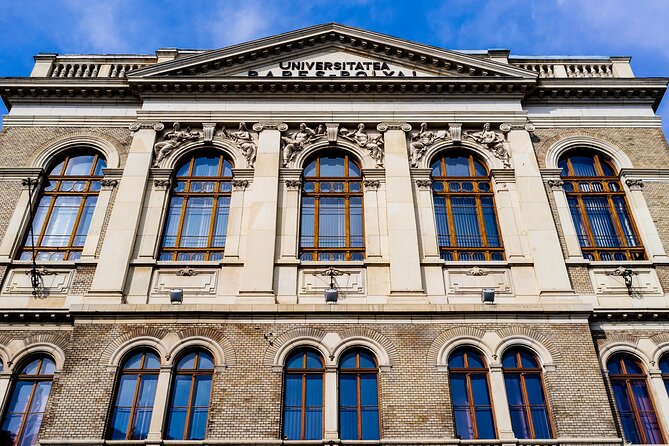
As you continue, you reach the Street of the Intellectuals, famous for educational institutions. A key stop is Babes-Bolyai University. This section is useful because it shows Cluj as more than an old-city museum. Education and ideas still shape the city.
What makes it more than just a campus walk is the way the guide uses the route to explain darker medieval chapters. You will learn about the fate of witches in Cluj in the Middle Ages, and also hear about the formation of guilds.
These topics can sound heavy, but the value is how they get grounded in place. You are not only collecting facts. You are seeing how communities organized themselves, how laws and beliefs worked, and why certain groups became targets. That helps you read the city as a system, not a collection of landmarks.
Same base, a completely different day:
- Curly Tour – Day trip from Cluj 🙂
★ 5.0 · 330 reviews - Cluj: Turda Salt Mine, Corvin Castle, Alba Carolina Tour
★ 4.8 · 184 reviews - From Cluj: Turda Salt Mine, Gorge, and Remetea Full-Day Trip
★ 5.0 · 84 reviews - Turda salt mine 4h tour from Cluj
★ 5.0 · 73 reviews
Defensive walls, guilds, and how the old city turns into the newer center
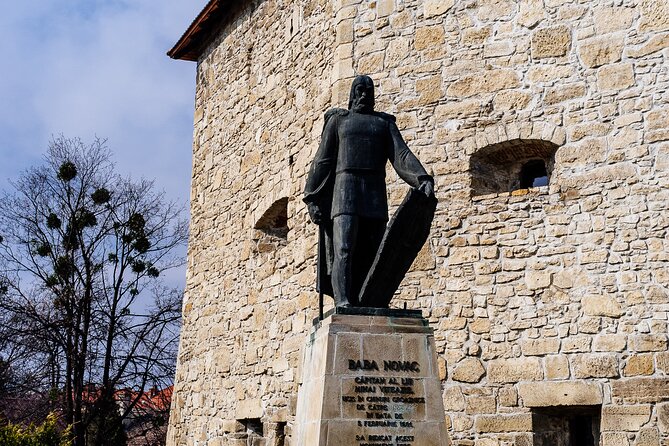
Along the route, you also pass the remains of the city’s defensive walls. Even when you can only see fragments, these leftovers do a lot for your understanding. They show how the city evolved outward from earlier limits, and how protection shaped where people built, traded, and lived.
The guild talk fits nicely here. Guilds formed to regulate trades, protect members, and organize economic life. When you connect guild formation to the defensive structure of a medieval city, the stories feel less abstract. You start to understand why “rules” mattered, and why the social world had sharp edges.
Then the walk shifts into a newer part of the old city, named Avram Iancu Square. That change of neighborhood energy is the point. It lets you see Cluj not only as medieval layers, but as a place that kept reinventing itself.
Avram Iancu Square: Orthodox Cathedral from the 1930s and the 1906 National Theatre
Avram Iancu Square is a highlight for people who like architecture with dates attached. Here you get the Orthodox Cathedral built in the 1930s, which gives you a clear view of Cluj as it moved through the 20th century.
Next door in spirit, you also admire the National Theatre built in 1906 by a team of Viennese architects. That detail is more than trivia. It points to the wider Central European influences that shaped how Cluj looked and how institutions were presented.
If you like standing in a place and understanding why it looks the way it does, this is one of the strongest ends to the tour. You start with Matthias Corvinus and Gothic St. Michael’s, then end with early-1900s institutional architecture and the 1930s Orthodox cathedral. That sweep makes the city feel whole, even in a short 2.5 hours.
How much walking is it, and what should you bring
This is a guided walking tour, so you should plan for real time on your feet. The good news is that the tour has built-in pacing, and some guides have taken the group to sit comfortably a couple times during the 2.5 hours. Still, the route is not described as slow-crawling.
What you bring matters:
- comfortable shoes
- a sun hat
- a face mask or protective covering
On the fit side, there is a mixed message worth noting. The activity is listed as wheelchair accessible, but it is also not recommended for people with limited mobility, and it is not suitable for people with mobility impairments. If you fall into that category, you should consider this a “confirm first” situation with the operator.
Also, no pets are allowed, so plan accordingly if you are traveling with an animal.
Price, value, and why the guides make a difference
At $34 per person for 2.5 hours, this is priced like a serious historical walking tour, not a quick show-and-tell. The value comes from how many major sights you cover in one coherent route: Matthias Corvinus sites, St. Michael’s Church, Union Square, the Street of the Intellectuals, remnants of defensive walls, and finally Avram Iancu Square with both the Orthodox Cathedral and the National Theatre.
You also get bilingual live guiding in English and German. That matters in Romania, where pronunciation and local context can make or break comprehension.
The other big value factor is guide quality. Many people praised guides by name, especially Daniela, and also described the experience as well paced, fun, and flexible when needed. One guide even stayed longer than the planned time in a case I saw, which tells you the guides take care to finish what they started when the group wants it.
Who should book, and who might want a different plan
This tour is a great fit if:
- you want a first-day orientation to Cluj-Napoca’s center
- you enjoy history tied to real places, not just a list of facts
- you like a guided mix of Gothic, medieval, and early modern architecture
- you want stories with human detail, including medieval witch trials and guild life
It may be less ideal if:
- you need more seated time or step-by-step accessibility support
- you want lots of inside access to buildings, since this sounds mostly geared to exterior landmarks and street-level learning
- you prefer a slower pace with long stops and deep museum time
Should you book this Cluj walking tour?
If your goal is to get oriented fast and understand why Cluj looks the way it does, I think this is a strong book. You get a well-structured route, major landmarks in a compact time window, and guide-led context that helps everything click.
My practical advice: bring comfortable shoes, expect a real walk, and if interior access is important to you, send a quick question before you go so you know what to expect. If you do that, you are set up for a fun, story-driven afternoon in the middle of the city.
FAQ
How long is the Cluj-Napoca guided walking tour?
It lasts 2.5 hours.
How much does the tour cost?
The price is $34 per person.
What languages are available for the live guide?
The live tour guide is available in English and German.
Where does the tour meet?
The meeting point may vary depending on the option booked, so you should check the specific details for your booking.
What are the main sights included on the walk?
You will visit the birth house of Matthias Corvinus, see St. Michael’s Church on Union Square, walk through the Street of the Intellectuals near Babes-Bolyai University, pass defensive wall remains, and reach Avram Iancu Square to see the Orthodox Cathedral and the National Theatre.
Is it wheelchair accessible?
It is listed as wheelchair accessible, but the activity also notes it is not recommended for people with limited mobility and it is not suitable for people with mobility impairments.
What should I bring with me?
Bring comfortable shoes, a sun hat, and a face mask or protective covering.
Are pets allowed?
No pets are allowed.
Can I get a refund if my plans change?
Yes. You can cancel up to 24 hours in advance for a full refund.
Latest reviews from around Cluj-Napoca
- 3 Day Tour of Maramures★ 5.0 · 4 reviews
- CJ01 – Explore Cluj-Napoca: A lively City Tour in English★ 5.0 · 4 reviews
- Golden Circle of Transylvania★ 5.0 · 5 reviews
- Turda Salt Mine, Gorge & Rimetea Village (private from Cluj)★ 5.0 · 5 reviews
- Private tour to Turda Salt Mine, Rimetea and Alba Iulia★ 4.8 · 5 reviews
- 650cc Motorbike Rental from Turda★ 5.0 · 5 reviews
- CJ04 -Maramureș Adventure:Tradition, Folk Art &Scenic Beauty★ 5.0 · 5 reviews
- Pub Crawl in Cluj★ 4.5 · 6 reviews
Walking Tours, compared.
Bucharest: City Highlights Guided Walking Tour
Read our review →
Bucharest: Communism and History Guided City Walking Tour
Read our review →

Bucharest: Hidden Markets Walking Tour with Tastings
Read our review →
Bucharest: Ghost Stories & Romanian Mythology Walking Tour
Read our review →
Bucharest: Guided Walking Tour with Romanian Snack
Read our review →
Walking Tour- Delightful Bucharest (Highlights, Stories, Sights)
Read our review →Browse the lists this tour appears in