
Reviewed · MONASTERIES
Day trip from Iasi to the UNESCO Painted Monasteries in Bucovina
These Painted Monasteries in Bucovina are interesting because they turn theology into outdoor art you can read like a film. I love the chance to see UNESCO-listed churches of Moldavia in one long day, and I also love how the private guide style keeps the fresco details from turning into a blur. One thing to consider: it is a 12-hour day, and the day works best if you are ready for a full schedule and some walking around active heritage sites.
The best part for me is that you get stories you can actually use while looking at the walls. Guides such as Mihai, Nicu, Iulian, and George are repeatedly praised for explaining what the scenes mean and how local culture shaped the images. If you want slow travel and lots of free time, you might feel rushed, since lunch is extra and the stops are timed tightly.
Key points before you go
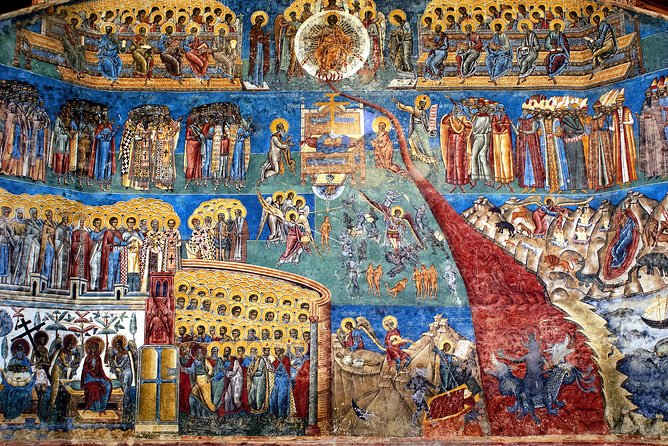
- Three UNESCO Painted Monasteries in one day: Voroneț, Moldovița, and Sucevița
- Fresco focus with a guide who helps you read the murals outside and inside
- Marginea black pottery visit to see how craft tradition is made by hand
- Hotel pickup in Iași plus modern transport, bottled water, and entrance fees included
- Small group size (max 7) makes it easier to ask questions and keep your pace
Bucovina Painted Monasteries: why these churches feel like something you can read
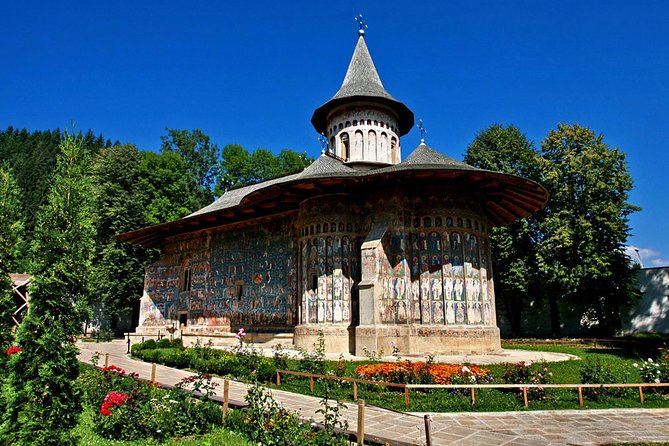
Painted Monasteries of Bucovina are not just pretty walls. They are big visual lessons, built for people who learned through sight, symbols, and community life. Even if you do not read Romanian, the images guide you. You start connecting the dots fast: who is shown, what scenes repeat, and how faith mixes with local belief and Eastern Orthodox thinking.
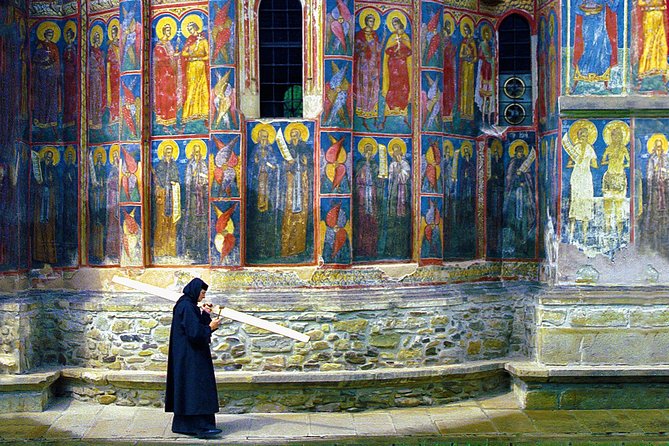
At each stop, the frescoes are the main event. The paintings are placed high on exterior walls, then continue inside. That is why a guided day works. A guide can point out what you might otherwise miss, like how certain scenes link to the local story of the monastery, not just generic Bible illustration.
You also get something that feels rare in day trips. The theme is consistent from morning to late afternoon: you are not hopping between unrelated sites. You are following one cultural thread, through church walls painted to last.
More painted monastery trips:
- Bucovina Painted Monasteries & Transylvania Tour: 4-Day Private
★ 5.0 · 6 reviews - 11-Day Romania Tour from Bucharest with Transylvania & Bucovina
★ 5.0 · 6 reviews - Transylvania & Bucovina Private Tour – 6 days
★ 5.0 · 3 reviews
Leaving Iași at 8:00, and what a 12-hour day trip really means
You start early, with pickup from any hotel in Iași at 8:00 am. The plan runs about 12 hours in total, using a modern vehicle. This matters because Bucovina is a long day from Iași. You want comfortable transport, and you want the day structured so you do not lose time to confusion.
This is also a small-group format, capped at 7 travelers. That size is big enough for a lively group conversation, but small enough that the guide can slow down when you ask questions. A private guide approach is built into the concept, so you should expect personalized attention rather than a lecture-style rush.
Expect a day rhythm: travel time, timed sightseeing blocks (about an hour at each monastery stop), and a craft visit. Walking is limited, but it is not zero. Think comfortable shoes and a water plan, even though bottled water is included.
Voroneț Monastery: the fast build, the preserved colors, and what to look for
Voroneț is often the first monastery people remember, and it is easy to see why. The monastery was built in 1488 in a remarkably short period, and today it is part of the UNESCO heritage. What stays with you is how the exterior murals still keep their hues after centuries of tough weather.
Plan to spend about 1 hour here, with your guide pointing you toward the stories painted on the outside and inside. The frescoes are not random decoration. They are arranged like a visual sequence, meant to communicate history of Christianity through local style, folk beliefs, and Orthodox thought.
A detail that makes Voroneț special is how the murals feel cinematic. You can stand at a distance and start noticing the structure of the scenes, then move closer and catch the smaller visual cues. If you like art that teaches, you will enjoy this stop a lot.
Possible drawback: because it is an icon of the region, you may find you want more than an hour once you are fully engaged. Still, the hour is usually enough to understand what you are seeing, and then you get the reward of moving on while your interest is high.
Moldovița Monastery: why these murals mattered to everyday life
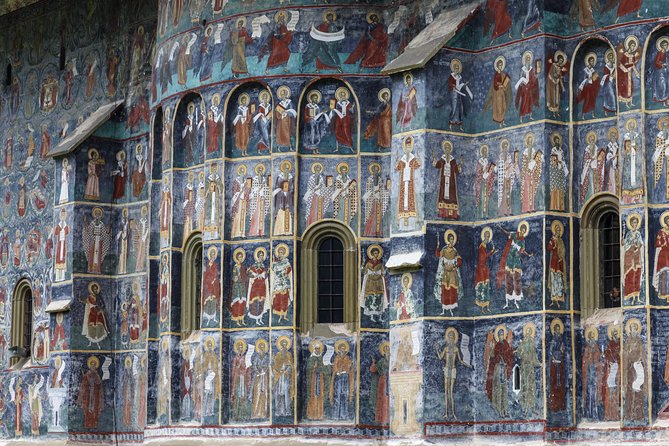
Next is Moldovița, included in UNESCO in 1993 and built between 1532 and 1537. Here the guide usually brings the frescoes into focus by explaining their original role. For centuries, murals were a way for people to learn Bible teachings when education access was limited.
The effect today is that the paintings read like a community record as well as religious art. Your guide can help you notice how scenes reflect both biblical subjects and the history of the place. That is the key shift. You stop viewing the murals as distant religious art and start seeing them as part of how a community understood itself.
You also get about 1 hour at Moldovița. This is long enough to walk the space, see how the fresco program repeats themes, and understand what you are looking at, especially with an English-speaking guide.
Tip for your visit: ask your guide to walk you through one mural sequence as a story, not just as separate pictures. When someone breaks it down that way, the exterior scenes can feel like chapters.
Sucevița Monastery: green pigments, and the mix of styles you can spot
Sucevița is described as the newest of the Painted Monasteries of Bukovina, and it is also UNESCO-listed since 1993. It was built in a style influenced by Moldavian design, with Gothic and Byzantine elements. That blend shows up in the overall look, while the murals are dominated by a shade of green.
The green is not just a visual effect. It is tied to ancient technique and natural pigments, the kind of detail guides love to explain because it connects art to materials. Again, you spend around 1 hour. With a guide, that hour turns into real understanding instead of quick sightseeing.
One practical note: green murals can be visually intense in bright light. If the sun is strong, you might want to pause in slightly shaded spots so you can keep seeing the fine details.
If you like variation across the trip, Sucevița delivers. After Voroneț and Moldovița, you get a different color mood and a different feel to the mural program. The day stays fresh rather than repeating the same wall theme.
Marginea black pottery: the craft stop that slows you down
Between the monasteries, the trip also includes Marginea, known for black pottery made by craftsmen. This is the part of the day that breaks the church-only rhythm.
Even with a busy schedule, this stop is valuable because it shows the living tradition behind the region’s identity. You are not only seeing heritage from the past. You are watching a craft that continues, and that helps the monasteries make more emotional sense. These places were shaped by the same local skill, local community life, and local pride.
The visit is guided as part of the day program. You can expect to learn how the black pottery is produced by craftsmen, which is the practical takeaway you can remember later. If you like hands-on culture, you will appreciate this more than just another photo stop.
The guide makes or breaks the day, and small groups help
This trip is built around an English-speaking guide, and the experience is designed for personalized attention. In practice, that means you are not stuck standing at the back while someone else reads the walls. You can ask questions, and your guide can adjust explanations based on what you seem to care about most, like religious symbolism, historical context, or how exterior and interior murals relate.
The guide names that come up for this experience include Mihai, Nicu, Iulian, and George, with a consistent theme: clear explanations and a friendly approach. Even when the art is complex, the goal is to make it understandable in plain language.
The group size also supports this. With a maximum of 7 travelers, you get a better shot at real back-and-forth. It is one reason the trip tends to score highly in satisfaction.
What’s included, what costs extra, and how the price adds up
The price is $244.57 per person, and the included package covers the big cost centers for a day trip like this:
- Modern transportation
- English-speaking guide
- Hotel pickup and drop-off in Iași
- Bottled water
- Entrance fees
Lunch is not included, and you should plan about €15 per person. That is normal for a tour day, but it is worth budgeting. If you skip lunch planning, you might end up paying more or settling for something you do not love.
So is it good value? For me, yes, because you are paying for a full day of guided heritage access plus long-distance transport from Iași, not just a quick self-guided outing. The included entrance fees matter because these monasteries are the core of the trip.
Lunch timing, local food, and the smartest way to handle it
Lunch is extra, around €15 per person. Because the day is timed, you should treat lunch like fuel, not an extended meal. Pick something filling and practical. If you are traveling with specific dietary needs, it is smart to plan ahead and ask your guide what options look realistic that day.
You do not want to spend your most energetic time hunting for food. The guide and schedule are there for a reason: the day is built to fit three UNESCO-painted monasteries plus the craft stop.
If you like local eating, this is also your chance. I would aim for a simple Romanian meal rather than searching for something unusual that takes longer to get.
What to wear and bring for fresco time and pottery time
You get a small amount of walking through heritage sites. Wear comfortable shoes you trust on uneven ground.
Pack a light layer too. Morning starts early, and the day can shift between travel and outdoor viewing.
Bring a phone charger if you like photos, but do not let it steal your attention. The best payoff is standing still long enough to let your guide’s explanation connect to what you see on the wall.
Since bottled water is included, you do not need to buy water immediately. Still, having your own small refill option can be handy.
Weather can change the day, so keep your flexibility
This experience requires good weather. If conditions are poor, the tour may be canceled and you are offered a different date or a full refund. This is not a reason to avoid the trip. It is a reason to stay flexible with your Bucovina plans and not stack other long-distance commitments for the same day.
On cancellation, you can cancel for a full refund up to 24 hours before the start time. That is useful if your schedule is still shifting.
Who should book this Bucovina day trip
Book it if you want:
- UNESCO-painted monasteries in one focused day, without having to plan transport
- Guide-led mural interpretation in English
- A small group day that still feels structured
- A craft stop in Marginea, so the trip is not only church walls
It is also a good match for art and culture lovers who like learning through real visuals, not just reading. If you are traveling with kids, note that children must be accompanied by an adult, and child pricing applies only when sharing with 2 paying adults.
If you hate day trips or want long free time, you may find the schedule tight. But if you come with curiosity and a comfortable walking pace, you should enjoy it.
Should you book? My quick decision guide
Yes, I would book this day trip if you want maximum value from one day in Bucovina. The price makes sense because transport, an English-speaking guide, entrance fees, and pickup are included, and the stops are tightly focused on the Painted Monasteries theme.
I would think twice if you strongly prefer slow travel. This is a full-day circuit with timed sightseeing blocks. Also, lunch is not included, so budget about €15 and plan to eat quickly.
If your priority is understanding the frescoes and seeing Voroneț, Moldovița, and Sucevița without the hassle of driving yourself, this is a smart way to do it.
FAQ
How long is the day trip from Iași to the Painted Monasteries in Bucovina?
The tour runs for about 12 hours.
What time does the tour start, and where do you get picked up?
Pickup starts at 8:00 am. The operator picks you up from any hotel in Iași.
What is included in the price?
The price includes transportation, an English-speaking guide, hotel pickup and drop-off, bottled water, and entrance fees.
Is lunch included?
No. Lunch is not included. It costs about €15 per person.
How many people are in the group?
The tour has a maximum of 7 travelers.
Is the tour suitable for children?
The tour states that most travelers can participate, and children must be accompanied by an adult. Child rates apply only when sharing with 2 paying adults.
More Monastery Visits in Iași
- 3-Castle: Peles,Bran,Rasnov,Sinaia Monastery from Brasov w pickup
★ 5.0 · 274 reviews - Peles Castle, Bran Castle, Rasnov Fortress and Sinaia Monastery Tour from Brasov
★ 5.0 · 55 reviews - Princely Court of Târgoviște and Curtea de Argeș Monastery
★ 4.5 · 50 reviews - Small Group Tour to Mogosoaia Palace & Snagov Monastery
★ 4.4 · 48 reviews
More of Iași
- Tour guide in Iasi, Romania
★ 4.9 · 14 reviews - Iasi City Tour
★ 5.0 · 12 reviews - Adventure day trip from Iasi | Hiking in the Carpathian Mountains
★ 5.0 · 10 reviews
Latest reviews from around Iași
- Iasi City Tour★ 5.0 · 12 reviews
- Adventure day trip from Iasi | Hiking in the Carpathian Mountains★ 5.0 · 10 reviews
- Tour guide in Iasi, Romania★ 4.9 · 14 reviews
Monasteries, compared.

3-Castle: Peles,Bran,Rasnov,Sinaia Monastery from Brasov w pickup
Read our review →
Peles Castle, Bran Castle, Rasnov Fortress and Sinaia Monastery Tour from Brasov
Read our review →
Princely Court of Târgoviște and Curtea de Argeș Monastery
Read our review →
Small Group Tour to Mogosoaia Palace & Snagov Monastery
Read our review →
Sacred Monasteries Private Tour: Snagov, Țigănești & Căldărușani
Read our review →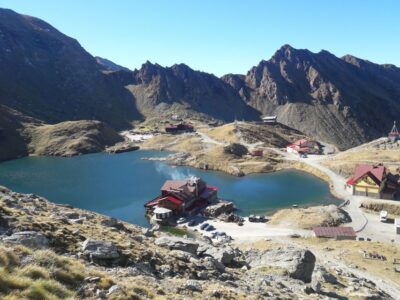
Brasov: Transfagarasan Highway, Balea Lake & Carta Monastery
Read our review →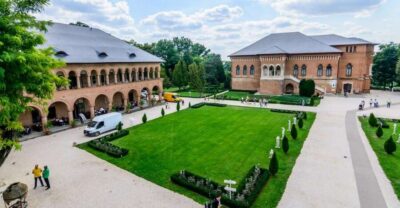
Private Half Day Trip to Snagov Monastery & Mogosoaia
Read our review →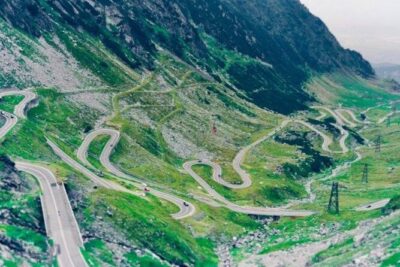
Hike to Poenari Fortress, Vidraru Dam, Argeș Monastery – Private
Read our review →Browse the lists this tour appears in